
How heavy should a weighted vest be? Walking and training with the Henkelion vest
How heavy should your weighted vest be? Match the Henkelion vest from 4 to 20 lb to your body weight, then start walking and training in it.
Read the guideAnkle weights at home

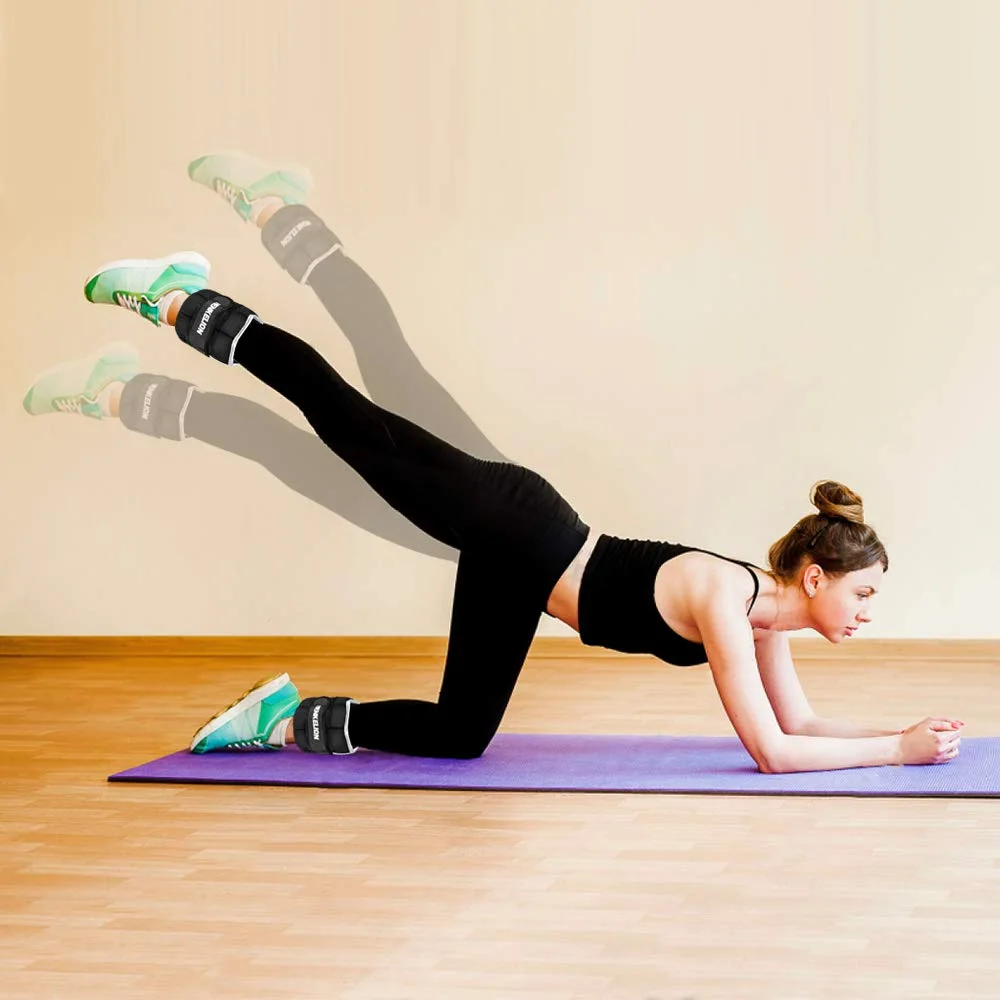
Put a pair of ankle weights on a mat in the living room and a plain leg lift becomes strength work. The trick is knowing where they belong. Leg lifts, glute work and slow moves at a chair suit them well. A brisk walk around the block does not, and the reasons are worth a minute before anything goes around your legs.
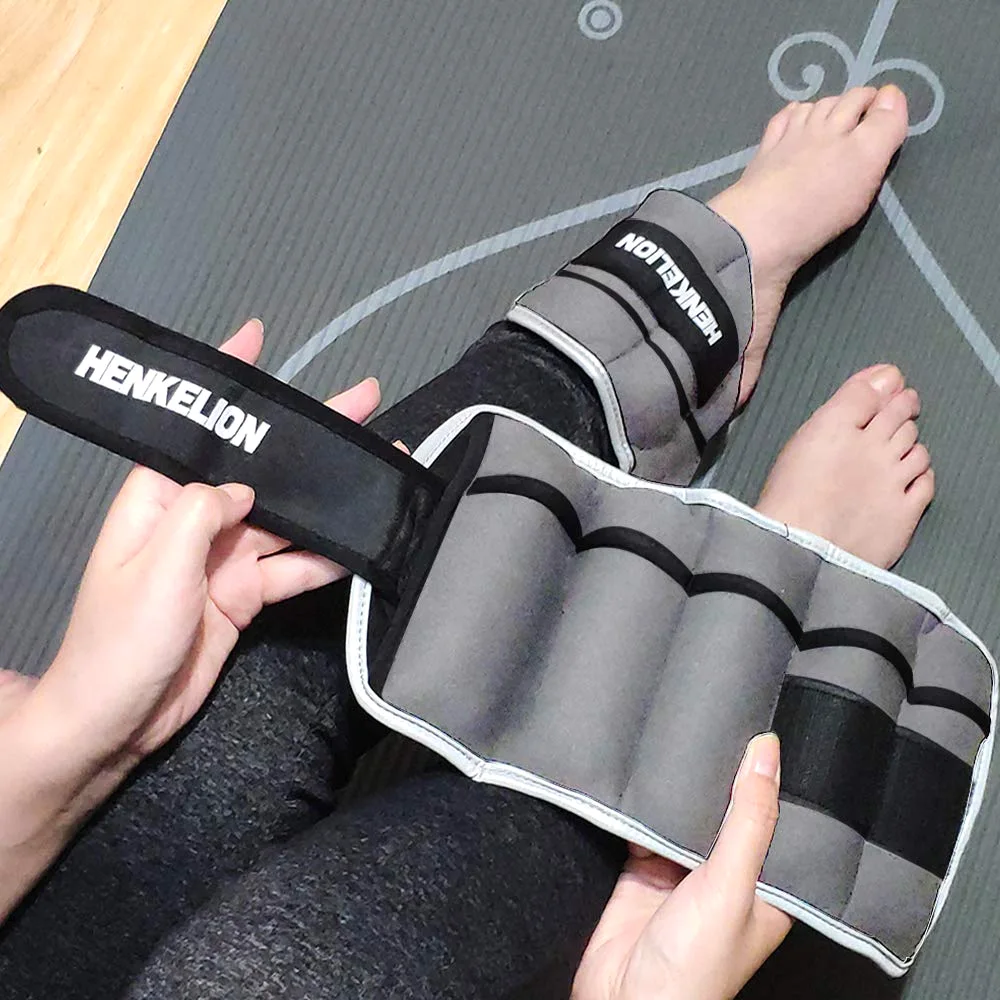
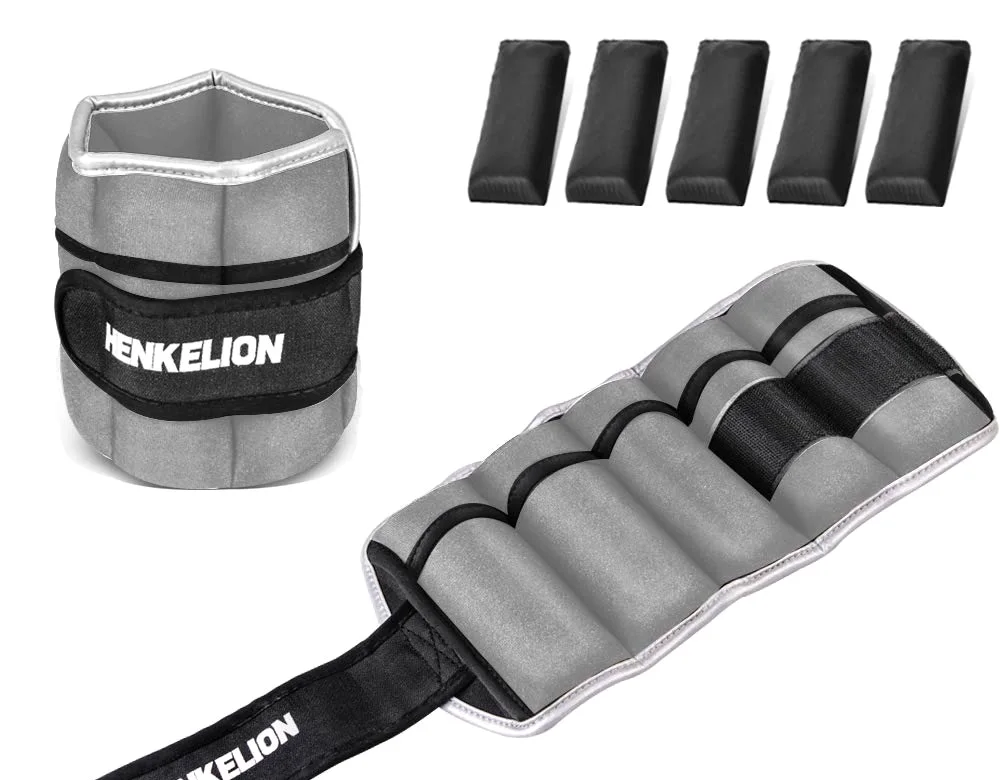
The Henkelion Adjustable Ankle Weights are sold as one pair, in four weights per cuff: 2 lb, 3 lb, 5 lb and 10 lb. That makes the pair 4, 6, 10 or 20 lb in total. Each pair ships with ten removable weight bags, five in each cuff, and those bags are how the load changes. Pull bags out of their pockets and the cuff gets lighter. Slide them back in and it returns to the weight of the option you chose.
A hook-and-loop strap closes each cuff, so the fit depends on how far you pull the tab before pressing it down. We cut the cuff in an elongated shape on purpose: it wraps an ankle, and the same cuff closes around a wrist. The outer fabric is mercerized cotton, which we picked because it breathes and soaks up sweat quickly. That detail matters more on a warm afternoon on the floor than in a cold gym. Set the cuff snug around the lower leg just above the ankle, firm enough that it does not slide toward the foot during a lift. Once closed, the strap should lie flat with no loose tab.
Colors run through black, gray, blue, pink and purple, though not every weight comes in every color. The 10 lb cuff is black only. Ankle weights were the first thing we sold in the US, in September 2018, and the cuffs now carry 14,986 ratings with an average of 4.6 stars.
Two practical points before you choose. First, the number on the option is the weight of one cuff with all five bags inside. A 5 lb pair means 5 lb on each leg and 10 lb in the box. Second, the bags only ever take weight away. Buy the 3 lb cuffs and 3 lb is your ceiling, so think about where you want to be in a few months, not only where you start.
Ankle weights
For leg lifts, glute work and wrist weights at home.

Strength work is one of the two parts of the federal advice on exercise. The Physical Activity Guidelines for Americans ask adults for muscle-strengthening activity on at least 2 days each week, next to 150 to 300 minutes of moderate aerobic activity. Ankle weights fit the first part of that sentence, not the second.
A physical therapist quoted by Harvard Health Publishing is plain about it: wearable ankle weights help with exercises that target the leg and hip muscles, such as leg lifts. The cuff adds load to the muscle you are aiming at, and that muscle has to lift it against gravity. Harvard pairs the advice with the side-lying leg lift. Lie on one side with both legs long, raise the top leg toward the ceiling with your hips stacked, hold, lower, and repeat 10 times before turning over.
Glute work at a chair is the other natural home for the cuffs. In a Harvard chair routine, the hip extension starts with the chair against a wall and you standing 12 inches behind it. Hold the chair back, tip your trunk forward to about 45 degrees and lift one straight leg behind you, then lower it slowly. The routine counts eight to 12 lifts per leg, done twice, and names ankle weights as one way to make the move harder.
What these moves share is speed, or rather the lack of it. The leg rises under control, pauses and comes down slowly, while the cuff stays close to the joint it loads. Nothing swings. A mat on the floor and a sturdy chair cover the rest of the kit, and Harvard's list of home equipment names both of them right next to ankle cuffs.
Strapping weights on and heading out for a walk looks like an easy upgrade. The same Harvard Health piece warns against it, and the reasons are mechanical rather than vague. On a walk or in an aerobics class, cuffs at the ankle push the work onto the quadriceps at the front of the thigh. The hamstrings at the back do less, and the therapist calls the result a muscle imbalance. With every step the weight also tugs at the ankle joint. Harvard links that pull to a risk of tendon or ligament injuries in the knees, hips and back.
Think about what a stride does. Your foot swings forward with every step, and each swing ends with the leg slowing down the extra pounds at the far end of a long lever. On the floor you move that load a dozen times on purpose. Out on a sidewalk the same load travels with you for every block, and tired legs change how you land long before you notice it.
Running repeats the problem with more speed and more impact. MedlinePlus counts running among the higher-impact activities that are more likely to cause injury than walking or swimming. It also names repeating the same motion over and over as a common cause of exercise injuries. Weight hung at the end of the leg makes neither of those gentler.
So keep the cuffs for the mat and the chair, and walk or run with your legs as they are. For load on a walk, Harvard treats a weighted vest as a separate case from wearable weights. It caps the vest at 10% of body weight and rules it out for people with back or neck problems. Wrist weights on a walk get the same warning as ankle weights: the arm swing builds an imbalance and can lead to joint and tendon injuries from the wrists up to the neck.
Start lighter than you think. Harvard's advice for people new to wearable weights is to begin with the smallest amount, as little as a pound or two, and raise the load gradually. Its guide to home strength equipment adds the other half of the plan. Choose cuffs with pockets for weight inserts, and look for ones that hold at least 5 pounds per leg so you can progress.
Our five removable bags per cuff are those pockets. A heavier cuff with bags taken out gives you a light start and room to grow without a second purchase. The light cuff, by contrast, stays light.
Here is how that plays out in practice. Say you are new to leg work and choose the 5 lb pair. For the first sessions you take most of the bags out of both cuffs and do your side-lying lifts with only a little weight on each leg. Whenever the last lifts of a set start to feel easy, one bag goes back into each cuff. In time all five are inside and you are working at the full 5 lb per leg. That path is the one Harvard sketches, and the cuffs follow it without a trip back to the shop.
The 2 lb pair makes sense if you know you will stay light, for example for wrist work or for slow moves after a long break. If you already train with weights and leg lifts at 5 lb no longer challenge you, the 10 lb cuff gives you the next range, and its bags let you begin it gently.
| Cuff option | Pair total | Bags you can take out | Typical use, from the sources |
|---|---|---|---|
| 2 lb each | 4 lb | any of the 5 in each cuff | The starting load Harvard describes: as little as a pound or two |
| 3 lb each | 6 lb | any of the 5 in each cuff | The next small step after that start, in line with Harvard's advice to raise the load gradually |
| 5 lb each | 10 lb | any of the 5 in each cuff | The 5 lb per leg Harvard tells you to look for so you have room to progress |
| 10 lb each (black only) | 20 lb | any of the 5 in each cuff | Above any load the sources name. Slow leg and hip work once 5 lb per leg is easy, with bags out until then |
When a set of 10 side-lying lifts feels easy at the end, add weight in one small step and leave everything else alone. MedlinePlus advises against raising three things at the same time: the number of days you exercise, how long you exercise and how hard you work. A bag slipped back into each cuff changes how hard. For that week, the days and the minutes stay where they were.
Before you pick a weight, our Henkelion size guide is the place to compare them side by side, and the Henkelion weights shelf shows the cuffs next to the vest and the dumbbells.
Because the cuff is long rather than round, it closes around a wrist as easily as an ankle. One pair can do two jobs.
Harvard's therapist sees a clear place for wrist weights: targeted arm work when you cannot grip a dumbbell, for example when arthritis or a stroke has weakened the hand. She names biceps curls and rows. For the row, lean over a ball or a table with your arms free at your sides, draw them back as if rowing a boat and squeeze your shoulder blades together. With a cuff on each wrist, your hands stay open and relaxed while the arms carry the load.
Close the strap just above the hand, so the cuff cannot slide onto the palm when the elbow bends. Arms may want a different load than legs, and the bags let you change it in about a minute. Take some out before the cuffs move up to your wrists, then put them back when the cuffs go down to your ankles again. Keep the removed bags in one spot near the mat, such as a small bowl or a zip bag. One left on the floor under a chair is easy to lose.
If your grip is fine, a dumbbell is the simpler tool for curls and presses, because the weight sits in your palm and goes down on the mat between sets. Our Henkelion Silicone Dumbbell Set is one pair of 3.3 lb dumbbells, 6.6 lb together, with a steel core inside soft silicone shaped to the palm and grip grooves along the handle. Both black and pink are available. In our home training photos the pink pair is held out in front during lunges and curled during squats while the weights stay on the body.

Dumbbells
For toning circuits, Pilates and walking intervals.
One rule carries over from the legs. Harvard warns against wrist weights during a cardio workout or on a walk, since swinging weighted arms back and forth can injure joints and tendons in the wrists, elbows, shoulders and neck. Curls, rows and slow presses are where the cuffs earn their place on your arms.
A session needs about the space of a yoga mat and one chair. Begin without weights. MedlinePlus suggests warming up by exercising slowly for the first few minutes and then picking up the pace, and a few minutes of marching in place does that job. Then strap the cuffs on.
Harvard's two routines give those counts. Rest between moves for as long as it takes to start the next one with control.
Two signals end a set early. MedlinePlus is direct that you should never feel pain when exercising and should stop right away if you do. Sore muscles the next day are expected, while sharp pain during a lift is not. The second signal is form: if the leg starts to swing or your hips roll back to help, take a bag out of each cuff and finish the set lighter.
Cool down the way you warmed up, with the last minutes at an easy pace. MedlinePlus puts the cool-down at 5 to 10 minutes. The federal guidelines ask for muscle-strengthening activity on at least 2 days each week, so two short sessions like this one fit their calendar. If you have back, joint or balance problems, Harvard's advice is to talk to your doctor before you buy wearable weights, and a physical therapist can help you set the starting load.
Keep reading

How heavy should your weighted vest be? Match the Henkelion vest from 4 to 20 lb to your body weight, then start walking and training in it.
Read the guide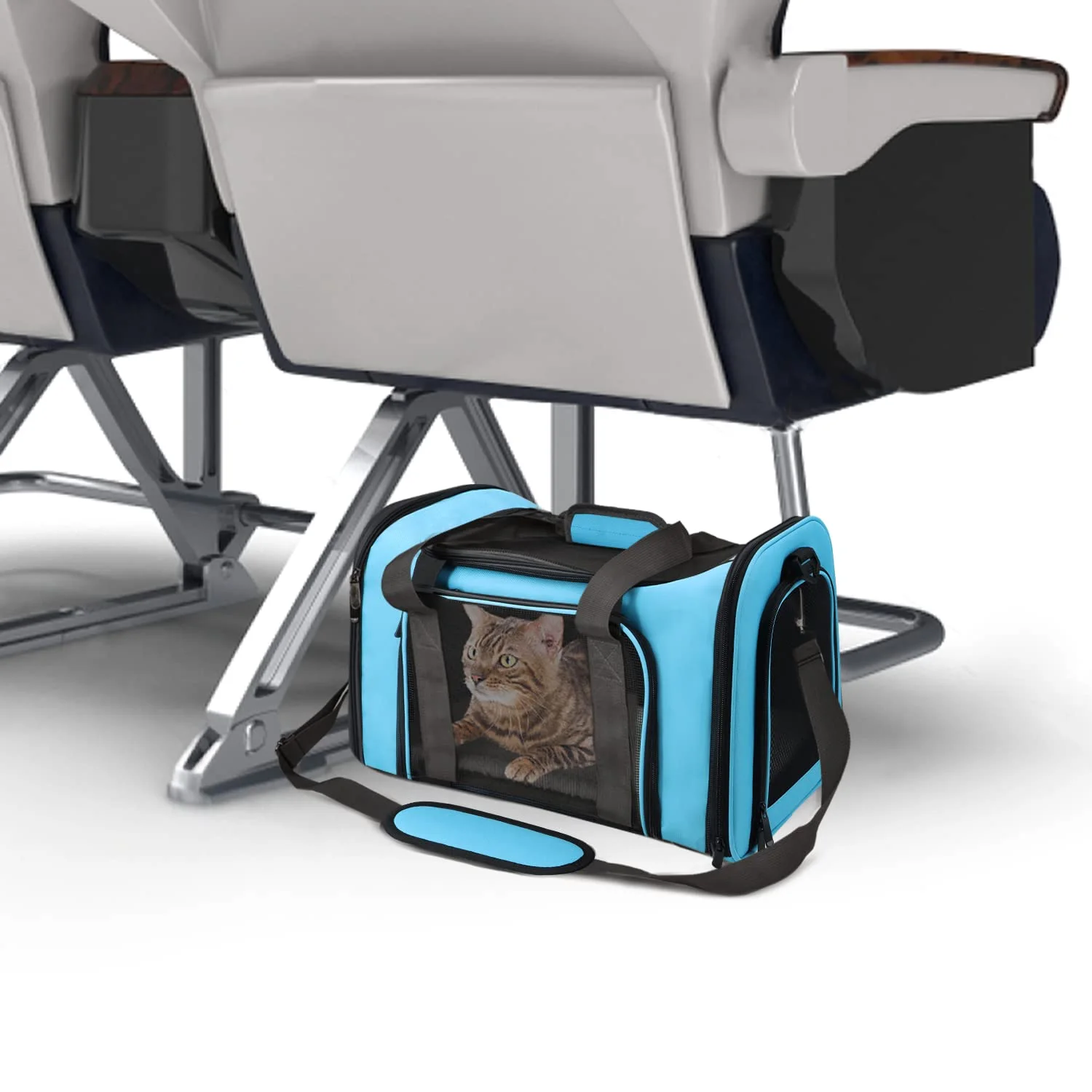
Medium or Large? Measure your cat or small dog, compare Delta, American and Alaska cabin carrier limits, and plan car rides and vet visits with Henkelion.
Read the guide
How big a litter box your cat needs, how many boxes for how many cats, where to put them, how deep the litter goes and how to wash a steel pan.
Read the guide